On October 17, 1961, Dynamo Kyiv won the gold medals of the USSR Championship for the first time in its history. The decisive match for the White and Blues was a meeting with fellow Ukrainians, Kharkiv’s Avanhard, in the penultimate round of the Soviet championship, which is the subject of this article.
For 23 years, Kyiv had been a regular participant in the country’s football championship, winning three silver medals and one bronze. The top prize, gold, had consistently gone to Moscow teams — Dynamo, Spartak and CSKA, joined by Torpedo in 1960, while Dynamo Kyiv had to settle for second place that season. But a year later, the goal the White and Blues had pursued for so long was achieved.
In the penultimate round of the 23rd USSR Championship, Dynamo hosted Kharkiv’s Avanhard in Kyiv — the lowest-scoring team among those competing in the final stage. Oleksandr Ponomariov’s men had scored just 26 goals, but they had also conceded the fewest of all teams — 24 (Dynamo had the second-best record).
The match in Tashkent between Pakhtakor and Torpedo had kicked off before the championship encounter in the Ukrainian capital. The hosts secured a surprise narrow victory, which helped Dynamo clinch the title ahead of schedule with a draw, as the Kyiv side had themselves drawn 1–1 with the car manufacturers in the previous round, preventing their main rivals from closing the gap.
Avanhard had its own objectives to pursue — the team was fighting for sixth place, which would allow its players to earn the title of Master of Sport, and had no intention of giving way to their fellow Ukrainians without a fight. The uncompromising Avanhard players not only built a solid defensive line, against which the hosts’ impressive combination play repeatedly broke down, despite Dynamo fielding their strongest lineup, but also occasionally responded with attacks of their own.

Early in the match, it was the Kharkiv side who could have taken the lead. Kroshchenko found himself one-on-one with Makarov, but Turianchyk managed to clear the ball for a corner at the last moment. At the other end, Bazylevych could have scored after a solo run, but sent the ball over the crossbar.
The visitors closely marked Dynamo’s forwards and attacking midfielders, with seven or eight players dropping back to defend. The Kyiv side tried to break through Avanhard’s wall with long-range shots, but even that proved difficult — the physically imposing defenders and experienced goalkeeper reacted in time.
Midway through the second half, Avanhard goalkeeper Mykola Uhraitskyi, who had dealt with every attempt by Dynamo to breach his goal, had to be substituted after being knocked out by a shot from Viktor Kanevskyi that struck him directly.
Lobanovskyi, Bazylevych, Serebrianykov, Kanevskyi and Troyanovskyi launched a final assault on the Kharkiv goal, supported from deep by Sabo and Turianchyk. Dynamo battled not only in the opposition’s half but also reached the six-yard box, yet the ball seemed bewitched and simply refused to go into the net. Avanhard managed to hold off the hosts’ technically gifted, fast and inventive forwards until the final whistle, which confirmed a goalless draw. With 43 points, Dynamo Kyiv became unreachable for their pursuers.
“The Avanhard penalty area has been trampled black by the home side, the paint on Uhraitskyi’s goalposts has peeled off from countless accurate shots, and he himself is soaked and barely able to stand after endless leaps. Yet the score is 0:0, 0:0, 0:0... The suffering of the players, the goalkeeper and the spectators would have continued for another 15 minutes at most when the announcer, his voice trembling, delivered the news: Torpedo had lost 0:1 to Pakhtakor in Tashkent” (Valerii Myrskyi, Fint newspaper, 1991).

“The 1961 season will remain forever in the memory of the fans: the brilliant, almost virtuoso performances of veteran Oleh Makarov; the self-sacrifice of the defenders; the unforgettable last-minute, perfectly timed sliding tackle by Vasyl Turianchyk against Avanhard, which saved the team from a certain goal; the rapid, explosive runs of Oleh Bazylevych; Valerii Lobanovskyi’s distinctive, effortless ‘stride’ and his peerless corners; the intelligent play of Viktor Kanevskyi, the organiser of attacks, a brilliant tactician and one of the championship’s top scorers; the reliable, tireless, ever-present midfielder and inside forward Yozhef Sabo; and Andrii Biba’s thunderous shots... Many kind words could be said about every player in the team, but it is difficult to single out any one of them... The championship victory was, above all, the result of the efforts of the entire team...” (Kyivskyi Komsomolets newspaper, 1961).
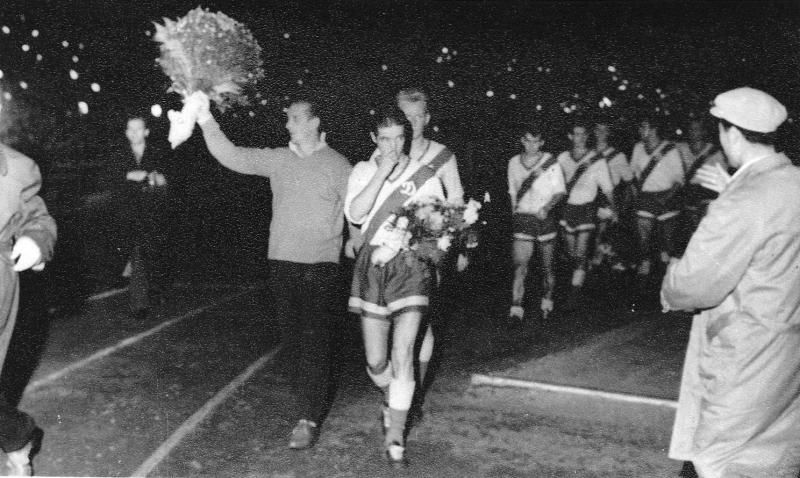
The 67,000-seat stadium was submerged in a sea of applause and, during Dynamo’s lap of honour, erupted in the famous flares made from newspapers, refusing to let their heroes leave the pitch for a long time. For the first time in the history of Soviet football, a team from Ukraine had become champions in front of its home supporters — Dynamo Kyiv had ended the dominance of Moscow clubs.
USSR Championship 1961
Dynamo (Kyiv) – Avanhard (Kharkiv) – 0:0
October 17, 1961. Kyiv. M.S. Khrushchev Republican Stadium. Attendance: 67,000.
Dynamo: Makarov, Koltsov, Shcheholkov, Suchkov, Sabo, Turianchyk, Bazylevych, Serebrianykov, Kanevskyi, Troyanovskyi, Lobanovskyi.
Avanhard: Uhraitskyi (Vlasenko, 65), Sokolov, Marienko, Todorov, Maslennikov, Ozheredov, Nesterov, Kostiuk, Panfilov, Koroliov, Kroshchenko (Khachaturov, 75).